A Slower Visit to an Unfamiliar Museum
A slower visit to an unfamiliar museum helps you choose a gallery, follow a question and notice more without trying to see the whole collection.
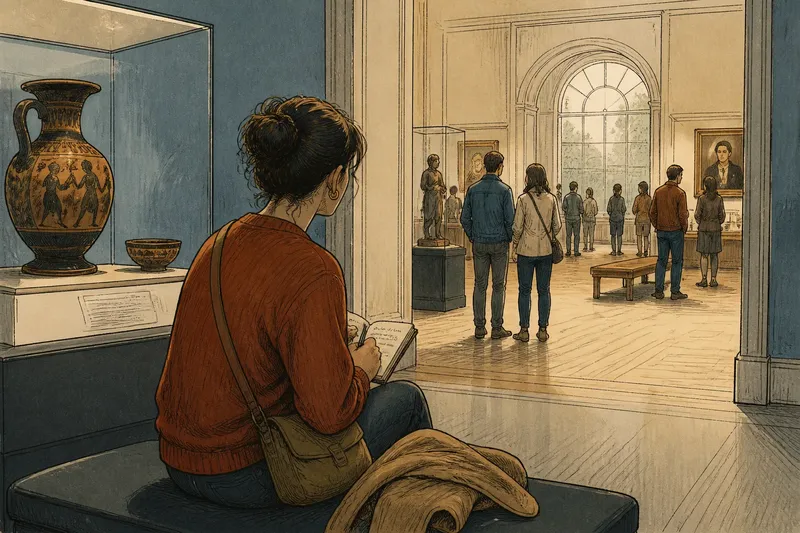
You are standing beneath a museum map, coat over one arm, trying to decide whether the Egyptian room is upstairs or beyond the café. A cluster of visitors moves towards the grand staircase. Instead of following them, you pick one gallery that catches your eye. A slower visit to an unfamiliar museum can begin with that small choice: less ground to cover, more attention for what is in front of you.
Choose one gallery instead of planning a full route
An unfamiliar museum can quickly turn into a string of decisions: which floor first, which famous object to see, and how to reach the next wing. Those questions may make the visit feel like route-finding before you have looked closely at anything.
Choose one gallery as your main destination. The map, entrance board or museum website might point you towards ceramics, migration or a temporary exhibition. Pick a room that sparks curiosity, rather than one that sounds important. You can decide what comes next once you are there.
Make the choice specific enough to remember. “The rooms with landscape paintings” is easier to hold in mind than “the whole upper floor”, especially in a building with several corridors and staircases. At the entrance, check the map for the gallery’s location, accessible routes, seating and any closures; then put it away until you need it again.
Let one question guide what you notice
A single question gives your attention somewhere to rest without dictating what the exhibition must mean. Try asking, “What does this room ask me to look at?” or “Which objects seem made for everyday use?”
You can choose a question before entering or let the first object suggest one. If a label says that an object travelled between places, you might wonder what details suggest movement, exchange or ownership. You do not need to know the definitive historical answer; notice what the question brings into view.
Keep the question open rather than turning it into a hunt for a fact. “Which object is the oldest?” may send you straight to labels. “What makes one object seem older than another?” leaves room for materials, wear, display choices and your assumptions about age.
One question is like a small tray: it gives you somewhere to place a few observations without asking you to carry everything. If it stops being interesting, replace it or set it aside.
Look at the object before reading its label
Give yourself a moment to notice an object’s shape, surface, scale, colour and position in the room before reading. Separate what you can see from what you are guessing.
Labels add context, such as a maker’s name, place, material or explanation of use. After reading, look back at the object: has a particular detail become clearer? If the label is long, read the opening lines and leave the rest if it does not serve your curiosity.
Say you enter a gallery of household objects wondering, “What makes an object feel familiar?” A painted bowl recalls one in a relative’s kitchen, though its decoration and setting are unfamiliar. You read that it had a different use, then look again at its rim and painted pattern; the result is a clearer sense of which detail prompted the memory and which detail changed it.
Your association is part of your encounter, but it is not evidence about the object’s history. You can hold both thoughts at once: “This reminds me of home” and “The label describes a different context.”
Notice how the display shapes your response
Museums are arranged spaces, not neutral piles of objects. A display case, wall colour, short label or gap between objects influences how you see them. An object placed alone may feel solemn; several similar pieces grouped together may seem more ordinary.
Notice your response without demanding that it become a grand insight. A portrait might prompt a thought about who gets remembered, or a tool might bring to mind work that usually goes unseen. Ask what prompted the thought: the object, its label, its neighbours or something you brought with you.
A short note can preserve an observation without turning the visit into an assignment. Write a phrase on your phone or a folded card, such as “blue glass, kitchen window” or “empty space beside the uniform”. Keep it private if you prefer.
If an exhibition brings up discomfort, grief or difficult memories, you can move to another room, sit down or leave the gallery. You do not have to pursue the feeling further.
Let the gallery set a comfortable pace
There is no required speed for looking. Some objects hold your attention briefly; others draw you back. You might sit on a bench or cross the room to see a display from another angle. Moving slowly does not mean studying everything equally.
Notice what affects your attention. A crowded doorway can make a label difficult to read, while glare on glass can hide a surface. If there is space, step aside for a clearer view; otherwise, move on and return later if you still want to.
If the room is tiring, pause before deciding what comes next. Find a seat, drink some water if you have it, or stand near the exit and check how you feel. A break belongs to the visit; it is not a failure to finish it.
You may find that a quiet stretch with one display feels more satisfying than a hurried circuit. If a nearby gallery makes you curious, follow that interest. Your first choice was a place to begin, not a rule to obey.
When should you change your plan?
What if the gallery I chose feels dull?
Look at a few objects, then leave if nothing catches your attention. Choose another room or follow a subject that interests you more.
Should I read every museum label?
No. Read the labels that help you understand an object or follow your question, and skim or skip the rest. Looking first can help you decide which information you want.
What if I do not understand the exhibition?
Start with what you can see: materials, arrangements, repeated shapes or contrasts. An introductory panel may provide context, but you do not need to grasp every curatorial idea to have a meaningful visit.
Can I visit without seeing the famous objects?
Yes. A famous object is worth seeking out if you are curious, but it is not a required stop. A quieter display may give you more room to follow your own question.
Leave with one observation, not a verdict
Before leaving the gallery, name one thing you noticed: a detail, a change in your question or a thought the exhibition stirred. You do not need to decide whether the exhibition was good or whether you saw enough.
If you want to continue, let your observation point towards another room. Perhaps you noticed how objects were grouped and want to see a different arrangement. Or perhaps you have had enough, and the café or exit is the right next stop.
A slower visit to an unfamiliar museum is not a way to extract a lesson from every object. It lets you enter without trying to master the building, the subject and your own reactions all at once. One gallery, one question and a little room to think can be plenty for a day out.
Keep your note somewhere you can find it later, if you wish. It may shape what you notice on another visit, or remain a thought from that room. You can leave the museum without turning the experience into a finished account before stepping back into the street.